For centuries, stars have sparked questions about the universe’s structure. While much attention falls on their brightness and composition, scientists now listen to them—literally. Through the study of stellar sounds, astronomers explore vibrations within stars that carry deep clues about their age, structure, and evolution.
Recent findings from the M67 star cluster, located nearly 3,000 light-years away, show that these internal “songs” don’t just echo through space—they tell intricate stories. Using Kepler’s K2 mission data, researchers tracked stellar activity throughout a star’s giant phase, revealing a surprising behavior that alters previous understanding of star evolution.
What Makes Stars Sing?
Most stars—including the Sun—feature turbulent outer layers filled with boiling gas. As bubbles of gas rise and burst near the surface, they generate ripples that travel through the star’s interior. These ripple patterns, called resonant frequencies, shape how a star vibrates.
Scientists detect these vibrations by studying changes in brightness. Since each star produces a unique blend of frequencies, astronomers can map them like musical signatures. By observing many stars within the same cluster, they isolate patterns that reveal group behavior.
These stellar sounds reflect each star’s physical properties, much like how the tone of a bell reveals its shape and size. Larger stars produce lower, slower vibrations, while smaller ones ring out with faster, higher pitches.
Star Clusters Offer Key Insight
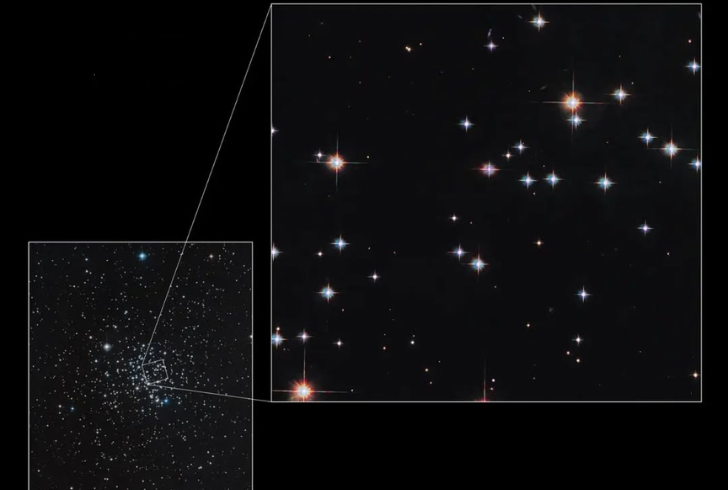
Instagram | educationnimbus | Scientists study M67 star cluster to learn how stars grow and change.
Clusters like M67 offer a rare scientific advantage. When stars originate in a cluster, they all have similar chemical compositions and form around the same time. That commonality allows scientists to observe how stars change without other variables clouding the picture.
Each star plays its own tune, but they share common notes. By analyzing those patterns, researchers can uncover stages in a star’s life cycle, identify age markers, and detect structural shifts hidden beneath the surface.
Cracking the Code of “Small Spacings”
One of the most revealing aspects of stellar sounds lies in what scientists call “small spacings.” These are closely grouped frequency bands that hint at a star’s internal dynamics. In younger stars, these frequencies help indicate how much hydrogen remains in their cores.
However, in red giants—older stars that have exhausted their hydrogen cores—the situation shifts. Scientists used to think these small spacings stopped being informative after a certain point. But new research proves otherwise.
A Moment That Changes Everything
During the study of M67’s red giants, astronomers noticed a strange phenomenon. As the hydrogen-burning shell around each star’s inert core expanded, the small spacings began to change. At first, the gaps grew wider. Then, as the shell moved inward, they narrowed again.
But then came a surprise—these spacings stalled.
At a specific moment in the star’s life, the frequencies stopped changing. This “stuck” sound marked a significant physical shift. Researchers found that when the star’s outer envelope—its hot, roiling surface layer—grew to encompass about 80% of the star’s total mass, it touched a highly sensitive inner region.
That region displayed dramatic shifts in sound speed, affecting how vibrations moved through the star. Once that boundary formed, it essentially “froze” the stellar song at a particular frequency.
What This Means for Astronomers
This newly identified stall point offers something incredibly valuable: a clear marker that can help determine a star’s mass, age, and composition with greater accuracy than ever before. By identifying when this stalling happens, scientists gain a new tool for classifying and aging stars in the giant phase.
This breakthrough doesn’t just apply to one cluster. Now that astronomers know what to look for, they can revisit seismic data from other stars across the Milky Way.
How Stellar Sounds Reveal the Galaxy’s Past

Instagram | thepathfinder_45 | Scientists hear stars and Milkyway history through sound patterns.
Stars act like time capsules. Each one carries evidence of the conditions where and when it formed. By studying stellar sounds, scientists uncover patterns that help reconstruct the timeline of the Milky Way.
Over billions of years, the galaxy has merged with smaller ones and created stars in bursts across various regions. Improved age estimates from these vibration studies allow astronomers to match star clusters with major events in galactic history.
Looking Ahead with New Ears
M67 doesn’t just offer clues about distant stars—it mirrors the future of the Sun itself. By observing stars similar in size and makeup, researchers can forecast how the Sun will evolve during its giant phase.
The results of this study give astronomers a new way to mine existing data. Decades of seismic observations from space telescopes like Kepler can now provide fresh insights using these updated techniques. And as more observations roll in, scientists plan to listen closer, knowing what each vibration might reveal.
These stellar vibrations aren’t just cosmic echoes—they’re messages waiting to be decoded. With the right tools and knowledge, astronomers now hear the universe differently, gaining deeper insight into both individual stars and the galaxy they call home.