Stars are the engines of the universe, shaping galaxies, creating heavy elements, and dazzling the night sky. Yet, some stars stand out for their sheer size—so large that they could swallow entire planetary systems. These cosmic giants spark curiosity: how do stars grow so enormous, and why do they not all reach such extremes? The answer lies in the physics of stellar life cycles, where mass, fusion, and radiation determine their fate. The Largest Stars Known One of the most famous contenders for the title of the biggest star is VY Canis Majoris, a red hypergiant about 6,000 light-years away. Its size is staggering—more than 1,500 times the diameter of the sun. Placed in our solar...
At the heart of the Milky Way, where stars orbit dangerously close to a supermassive black hole, some of them may be living on borrowed time—or not aging at all. New research explores an extraordinary idea: certain stars near the galactic center might be powered not by fusion alone, but by the energy released from collisions between dark matter particles and their antimatter counterparts. This concept doesn’t just challenge conventional models—it reshapes what we understand about stellar evolution. What Shapes a Star's Life? The foundation of a star’s life lies in its mass. Mass determines how quickly a star burns hydrogen, when it moves on to heavier elements, and how it ultimately fades. The "main sequence"...
Life rarely stays in a straight line, and this week, two zodiac signs are about to feel that truth more than ever. Aries and Pisces are entering a stretch filled with surprise shifts, fresh opportunities, and internal tests. Whether it’s a career jolt or a subtle nudge toward personal growth, both signs could experience moments that disrupt their routines—but in a way that ultimately leads to growth. When astrology signals change, it’s not always chaos—it can also be a call to reframe and realign. And this week, Aries and Pisces are in the cosmic spotlight. Unexpected Momentum for Aries For Aries, this week isn’t just about fast moves or bold leaps—it’s about measured courage. While a...
Gemini brings a unique kind of energy to the zodiac. With birthdays spanning from May 21 to June 21, this air sign is ruled by Mercury—the planet known for swift communication and intellect. Represented by twins Castor and Pollux, Gemini naturally embodies duality. They move effortlessly between perspectives, balancing logic and creativity in a way that keeps everyone guessing. Always seeking something new, Gemini rarely stays in one place for long. Whether switching topics mid-sentence or moving between friend groups, their energy keeps things dynamic. It’s this vibrant, curious nature that often earns Gemini a reputation as the most social sign in the zodiac. The Mind Behind the Wit Gemini operates with remarkable mental speed. Conversations...
For centuries, stars have sparked questions about the universe’s structure. While much attention falls on their brightness and composition, scientists now listen to them—literally. Through the study of stellar sounds, astronomers explore vibrations within stars that carry deep clues about their age, structure, and evolution. Recent findings from the M67 star cluster, located nearly 3,000 light-years away, show that these internal "songs" don’t just echo through space—they tell intricate stories. Using Kepler’s K2 mission data, researchers tracked stellar activity throughout a star’s giant phase, revealing a surprising behavior that alters previous understanding of star evolution. What Makes Stars Sing? Most stars—including the Sun—feature turbulent outer layers filled with boiling gas. As bubbles of gas rise and...
Celebrity relationships are always in the spotlight, and while some couples seem destined for a fairytale ending, others may face cosmic roadblocks. With astrology playing a significant role in personalities and compatibility, certain zodiac pairings might find it harder to navigate love in 2025. The upcoming planetary shifts could amplify differences, creating tension in relationships that might otherwise appear strong. Here are some high-profile couples who could face astrological challenges in the coming year. Selena Gomez and Benny Blanco Being both water signs, Selena and Benny should naturally connect on an emotional level. Their relationship is built on intuition, creativity, and deep feelings. However, astrology forecasts for 2025 suggest that Pisces may struggle with expressing emotions...
Discovery of Ice Around Baby Stars Offers Clues to Earth’s Water Origins
Water is fundamental to life, but its journey to Earth has long puzzled scientists. Observing ice around infant stars could provide crucial clues about where our planet’s water came from.
Recent studies using the James Webb Space Telescope (JWST) are revealing how the water in star-forming regions might resemble the water on Earth, helping scientists understand how planets can become habitable.
The Role of Semi-Heavy Water
One key to uncovering the origins of Earth’s water lies in semi-heavy water, or HDO. In this molecule, one hydrogen atom is replaced by deuterium, a heavier version of hydrogen containing a neutron. Water with a higher HDO-to-H2O ratio typically forms in extremely cold environments, like the dense clouds of gas, dust, and ice where stars are born. Interestingly, Earth’s oceans have a higher HDO ratio than the Sun, suggesting that some of our water may have originated in the cold interstellar cloud that birthed the Sun.

Instagram | friendsofnasa | Semi-heavy water (HDO), which forms in cold, star-forming clouds, is key to tracing the origins of Earth’s water.
Understanding how the HDO-to-H2O ratio evolves around young stars is essential for piecing together the history of water in our solar system. These ratios serve as chemical markers, providing insight into the conditions under which planets acquire their water.
Observing Ice Around L1527
The JWST captured detailed observations of L1527, a star just 100,000 years old. Though tiny compared to our 4.5-billion-year-old Sun, L1527’s size and surrounding dust indicate it could grow to resemble our star. Dust and gas around L1527 form a disk. Some of this material falls onto the star, while the rest may eventually come together to form planets, similar to how the solar system developed.
The telescope also detected a relatively high HDO-to-H2O ratio in the icy material surrounding L1527. By comparing this ratio with those around slightly older stars, researchers found that the proportion of semi-heavy water stays fairly stable as stars evolve.
This discovery allowed scientists to link these ratios to water found on comets and meteorites in our solar system. In this way, distant star-forming regions can be connected to the water present on Earth.
Comparing Ice Across Space

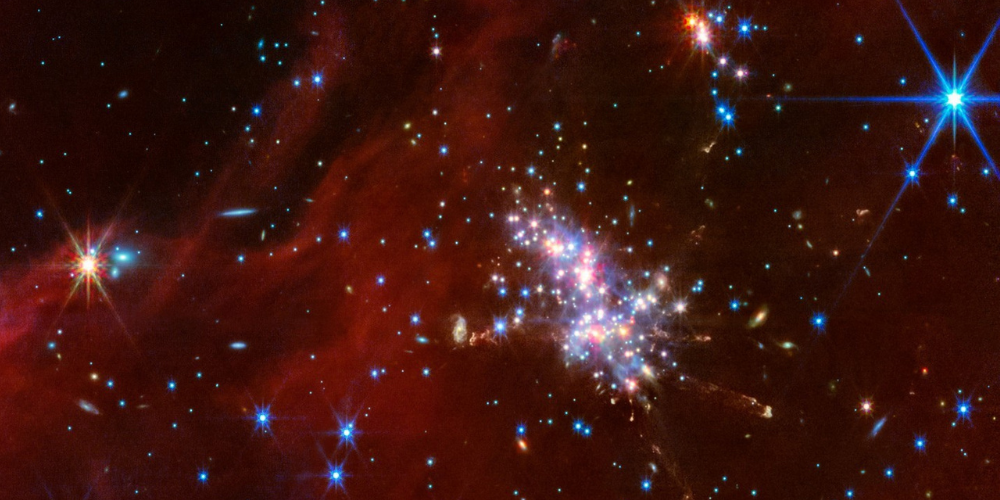
Instagram | nasa | By studying clustered and isolated stars, scientists assess the environmental effect on water.
Astronomers mapping semi-heavy water across star-forming regions have begun to connect the dots between interstellar ice and planetary oceans. Their work spans both gas and solid forms, focusing on:
- Carbonaceous Meteorites – Primitive asteroids that may have delivered Earth’s first water. Their HDO/H₂O ratios mirror those of young molecular clouds.
- Oort Cloud Comets – Believed to have formed far beyond our solar system, these icy bodies offer a glimpse into how water chemistry varies across stellar nurseries.
- Jupiter Family Comets – Born closer to the Sun, these comets act as time capsules, helping scientists understand how water migrated and endured in the solar system’s inner regions.
- Young Stars in Clusters vs. Solitary Systems – Comparing stars that form in groups with those developing in isolation allows researchers to see how the environment shapes water’s evolution and stability.
- Using the JWST, scientists also observed larger, brighter infant stars to broaden their dataset. When these measurements are compared with Earth’s ocean water, they begin to paint a picture of how water traveled from interstellar ice to worlds capable of sustaining life.
- Implications for Planetary Habitability
- Findings from the L1527 system reveal that icy materials play a vital role in forming planets. The stable ratios of semi-heavy water suggest that much of a system’s water survives the tumultuous early phases of star birth—a hopeful sign for the potential habitability of planets elsewhere.
This suggests that planets forming in these disks may inherit water with chemical traits similar to Earth’s. Observing both ice and gas around young stars helps scientists better understand water’s origins.
These studies reveal how life-essential molecules travel across the galaxy and may reach habitable worlds. Studying ice around baby stars also provides clues about Earth’s water. This brings researchers closer to solving the mystery of how water—and possibly life—spreads across the universe.